Astrobiology
Welcome to the fascinating world of Astrobiology—the scientific study of life in the universe! This comprehensive course is designed to explore the origins, evolution, and potential for life beyond Earth. You’ll dive into topics such as the beginnings of life on our planet, extreme environments where life thrives, and the exciting search for extraterrestrial life on Mars, Europa, and beyond.
4.3/5 (132 Ratings)
This course includes:
- Lifetime Access
- Access on mobile or desktop
- Certificate of Completion
What will you learn?
Introduction
-
Introduction to Astrobiology
00:31
Astrobiology
-
What is Astrobiology?
01:09 -
The Scientific Method in Astrobiology
01:13 -
Origin of Life
01:31
Life on Earth: Understanding Our Roots
-
Defining Life: Characteristics of Living Organisms
01:44 -
Extremophiles: Life in Extreme Environments
02:02 -
Evolution and Adaptation of Life on Earth
01:27
Life in the Cosmic Context
-
The Building Blocks of Life in Space
01:32 -
The Goldilocks Zone: The Search for Habitable Planets
01:18 -
Types of Stars and Their Habitability
01:43 -
Exoplanet Exploration: The Hunt for Earth 2.0
01:15
Life in Our Solar System
-
Mars—The Red Planet and the Search for Life
02:07 -
Europa—Jupiter’s Icy Moon
01:35 -
Enceladus—Saturn’s Tiny Moon with Geysers
00:00 -
The Ongoing Search—Missions and Tools
01:30 -
Module Summary
00:00
Life Beyond the Solar System—The Search for Exoplanets
-
The Discovery of Exoplanets
01:55 -
Types of Exoplanets
01:28 -
Habitable Zones and the Conditions for Life
01:57 -
Biosignatures—Signs of Life on Other Worlds
01:43 -
Module Summary
00:00
The Origins of Life on Earth—What Can It Teach Us?
-
Early Earth and the Building Blocks of Life
01:55 -
Theories on the Origin of Life
00:00 -
The First Life Forms on Earth
00:00 -
Module Summary
00:00
Life in Extreme Environments—What Does It Tell Us About Life Elsewhere?
-
Types of Extreme Environments on Earth
00:00 -
What Extremophiles Teach Us About Life on Other Planets
00:00
The Search for Life Beyond Earth
-
What is the “Habitable Zone”?
00:00 -
How Do We Search for Exoplanets?
00:00 -
Biosignatures—How Do We Know If There’s Life?
00:00
Life in Extreme Environments—Analogues for Extraterrestrial Life
-
Extremophiles—Life at the Edge
00:00 -
Mars—Could It Support Life?
00:00 -
Europa and Enceladus—Oceans Beneath the Ice
00:00
The Future of Human Exploration and Astrobiology
-
Human Missions to Mars and the Search for Life
00:00 -
The Moon as a Base for Astrobiology
00:00 -
Beyond the Solar System—Astrobiology and Interstellar Travel
00:00 -
Our Place in the Universe
00:00
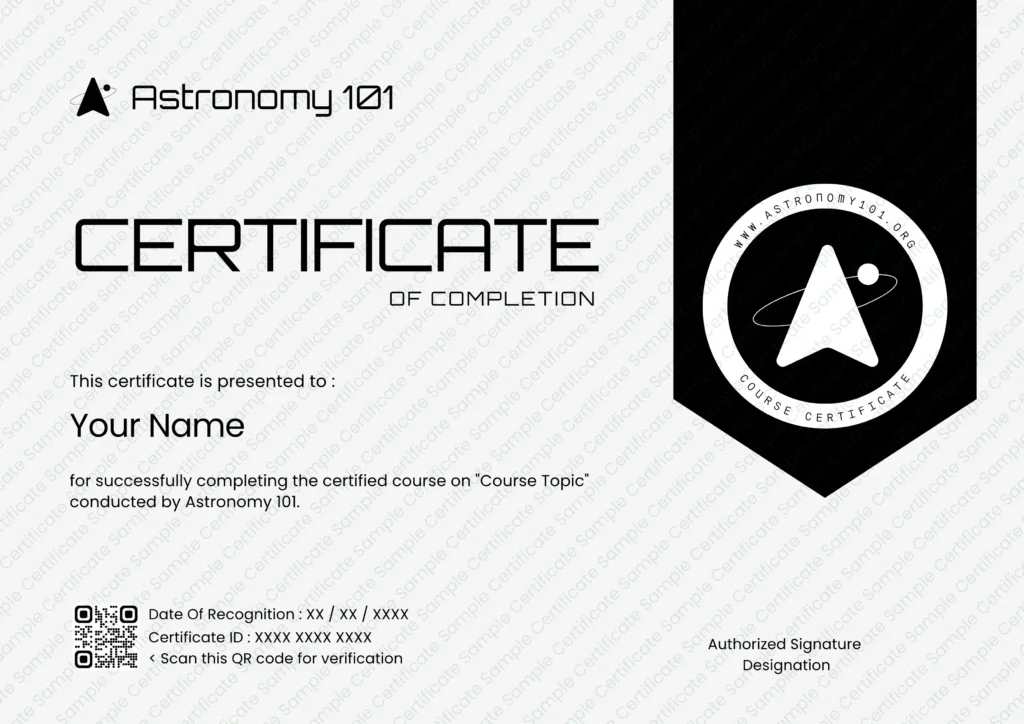
Get Certified Free
You can download your certificate for free when you complete this course.
Free Lifetime Access
You can start and complete your enrolled courses at anytime as you wish in your lifetime. You will also have free access to the future updates in your enrolled programmes even if you have completed them.
Access Anytime Anywhere
Access & learn your courses from anywhere around the world using yout smartphone or PC.
Learn & Get Free Certificates
Earn a free valid certificate for every course listed on our website.
-
Globally Recognised Certificate
-
Sharable on Linkedin
-
Bolt Speed Verification
Frequently Asked Questions
Space education plays a vital role in inspiring curiosity and driving innovation. Learning about space encourages young minds to explore the unknown and think beyond traditional boundaries. This sense of wonder often leads to creative ideas and groundbreaking technological advancements, not only in space exploration but also in other areas of life. From improved medical devices to advances in materials science, space education fosters a culture of innovation that has wide-reaching effects.
Moreover, space exploration has led to significant technological developments that benefit society in numerous ways. Many of the technologies we rely on today, such as satellite communications, GPS, and even medical imaging, have roots in space research. By educating people about space, we continue to push the boundaries of technology, enabling further progress in various fields. This continuous innovation helps improve the quality of life and addresses global challenges.
Space education also promotes global collaboration. Space missions require countries to work together, sharing knowledge, resources, and expertise. This cooperation sets an example of how nations can collaborate on large-scale projects for the benefit of humanity. Through space education, students learn the value of international teamwork and the importance of cooperation in solving complex problems.
In addition to technological and collaborative benefits, space education fosters a deeper understanding of Earth’s environment and the need for sustainability. Studying space helps us recognize the delicate balance of ecosystems on our planet and the importance of protecting them. As we explore other worlds, we also learn valuable lessons about caring for our own, encouraging a mindset of environmental stewardship and responsibility.
Space education is also a key driver of interest in STEM (science, technology, engineering, and mathematics) fields. It captivates students and inspires them to pursue careers in these essential disciplines, which are vital for future technological and scientific breakthroughs. By promoting STEM education, space learning ensures that future generations are equipped to tackle the challenges of tomorrow.
Understanding space also helps us reflect on humanity’s place in the universe. It opens up philosophical and ethical discussions about the meaning of existence, our responsibilities as a species, and how we should approach future exploration. Finally, with the space industry expanding rapidly, there are growing economic opportunities in areas such as space tourism, satellite development, and planetary research. Educating students in space-related fields prepares them for careers in this emerging sector, creating a well-informed workforce ready to take on the future.
No, There are no additional charges. Its all free.
No, You can download your free certificate from your dashboard itself when you completes the course
Yes, all our courses are mobile friendly. It will always be ♥️.
We are focused on providing affordable and accessible space education to anyone, anywhere across the globe.